Life continues........................


With stock markets crashing and yesterday’s kings becoming regents, there have been talks as to why their ex-queens should not bear the same fate. In a recent article written by Matthew Lynn (Bloomberg), he points out how such wives enjoy their holidays in tax havens when their former better halves are down in drains.
The answer for this: Divorce Derivative. So how will this work?
The value of the contract will be linked to the prevailing economic condition of the counterparties. So if the markets are booming or any one of the investments that the husband made started paying dividends after the divorce, the price goes up. And thanks to Mark-to-market rules this can be settled daily. On the other hand let’s say the wife gets a new khazana (like marrying a an oil baron) she would have to pay the husband a determined sum. How the instruments will be priced and how they will be sold is left to the intellectual capabilities of us Financiers. But till then don’t cheat on your husband or wife.
 With the global economy going southwards and consumer spending at record lows, even fastfood joints in the US are seeing a sea of change in their customer base. To loosen the noose around customer’s money bag they have started introducing 1$ menu items. This was started by Taco Bell, though at that time it was meant to take on McDonald’s than anything else. Surprised by such an audacious move, McDonald’s launched its own dollar menu. This dollar menu included not only burgers but also lattes, the latter starts at a $- plus prices.
 During all this, Starbucks was being severely censured by its critics for not targeting the mass customer. But that was then. Now, as everybody concurs, the 4$ latte is more of a luxury. And so to retain its customers, Starbucks has started offering 1$ coffee. There is a catch here, though. The coffee is not brewed, rather its an instant version. These packages are targeted people who don’t have the luxury to wait for their coffee.
But it raises some serious questions. Starbucks coffee has always been associated with class. An image that portrays a successful person who has the time and money to enjoy the Starbucks barista. Would this image be diluted because of launch of the instant coffee? Would customer’s who can still afford to pay $4 or more for a coffee still go to Starbucks? Only time will tell.

When you enrol yourself for a management education the professors and people concerned bog you down with so many concepts that you end up thinking why in h***’s name am I studying all these. So I launched myself into this endeavour of finding out whether these can be applied to a person’s real life and since there are so many, I decided on writing them down as a series. The first concept I selected for this series is the Porter’s Five Forces and its Applicability in Love.
I assume that i won’t considered too shallow for writing the above and I hope that this would encourage all those not interested in academics to polish their basics.


The above shown images are the screenshots of The New York Times and The China Perspective (a leading Chinese daily). The similarities in the two websites are outrageous. Even the various news tabs and their alignment have an uncanny resemblance. I am not pretty sure who tried to emulate who, but whoever is the one inspired (as they say in the Indian film industry), my humble request is please try to get a grip on yourself. Creativity is still not dead. Maybe, if you tried harder you could create a better page.
All developing countries should have huge forex reserves. A finance pursuant considers this knowledge as pedestrian. You are supposed to know this. But surprisingly, this concept did not emerge till the 1990’s Asian currency crisis. Till then emerging (developing) countries spent and the developed ones saved.
Well, so why am I raising this point?
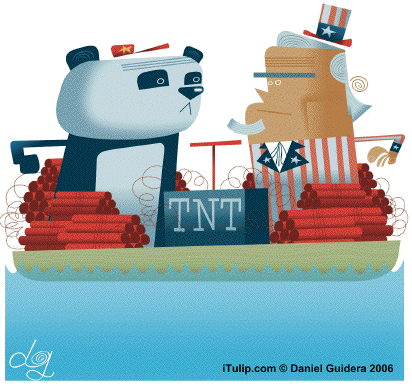
Because, as is emerging now, the developed countries (read USA) might not be the sole culprits for the financial quagmire we are in today. The aftermath of the Asian financial crisis was many countries devaluing their currencies to promote exports. This led to a surge in exports to the US which inturn was followed by a huge inflow of dollars into these developing economies. These were then invested in US Treasury securities bringing down the interest rates there.
So as is the law if nature, “Every action has an equal and opposite reaction.” For the Asian economies to run gargantuan trade surpluses, developed countries like the US had to run similar trade deficits. So from a savings rate of 6% the US household savings came down to zero. This ofcourse, was not maintainable leading to the US bubble burst.
If the global economies hope to come out of these dire times soon, they have to realize that though it is requisite for the US to start saving more but more important is the need for Asian economies to start spending.
(For further reading consult Swaminomics in TOI dated 8th Feb)


 Posts
All Comments
Posts
All Comments